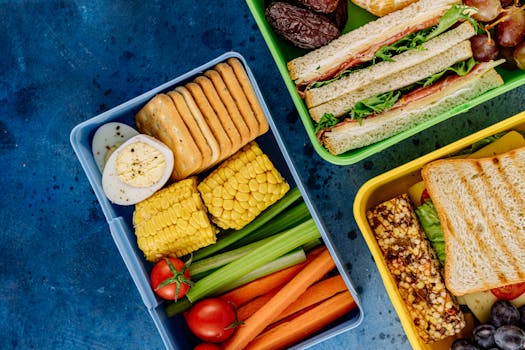
Prepping our lunches every evening is a firm ritual in our family. We do not go out for lunch, we each take along our packed lunches – to work and to school. So unless there is a company lunch or school party happening, three sets of lunches must be packed every work- and school night. No one in our family enjoys lunchbox prep. Over the years the task has been passed back and forth from one to the other, and even now we frequently try to bribe our way out of it (“If you do the lunches I’ll give you a foot massage!”). We even tried to get our then 5 year old to pack his own lunch – a task which he found both exciting and overwhelming. To help him understand what and how much of everything should be in his lunchbox each day I developed a simple modular system, which turned out to work incredibly well! It removes most of the decision making and mental workload, and the task ends up being somewhat more enjoyable. Plus, it saves time and money by keeping things simple!
The Modules
Our lunchbox contents are split up into categories reflecting the basic food groups:
- Protein
- Carbohydrates
- Fruit and Vegetables
- Treat
- Lunch (leftovers from previous night’s dinner)
Each lunchbox has to contain something of each category. I keep our fridge and pantry well-stocked with suitable and minimally processed or even homemade options. A handwritten sheet on our kitchen cupboard door also lists examples of foods to pack for each category, meaning the ‘packer’ only has to grab the item, perhaps wash or slice, and then pack it.
Example Foods
Here are some of our most popular food options! This list contains what works well for our family where there are no dietary restrictions or food allergies to consider. Of course we each have our personal preferences, but we find this approach flexible enough to accommodate each individual. Still, food allergies, dietary restrictions, dietary preferences and even macro goals and calorie counts can easily be accommodated by making sure suitable options are on hand.
Protein:
- Boiled eggs
- Cheese cubes
- Sausages
- Protein balls/Bliss balls
- Yoghurt
- Tuna salad
- Pulled Chicken
- Meatballs
- Chicken nuggets
Carbohydrates:
- Sandwich
- Burrito
- Muffin, savoury
- Crackers
- Sushi
- Popcorn
Fruit and Vegetables:
- Apple slices
- Carrot sticks
- Berries
- Cherry tomatoes
- Grapes
- Cucumber
- Avocado
Treat:
- Cookies
- Muesli bar
- Dried seaweed
- Chocolate milk
- Trail mix / berry and nut mix
Leftovers – a separate container with last night’s leftovers to be heated in the microwave
Tips and Tricks
We have tweaked this system over the years to make it perfectly fit our needs – and it works incredibly well! I am sharing the following tips and tricks to help you on your own journey with building your very own modular lunchbox system.
Containers:
Having the right container on hand makes a world of difference. In New Zealand a very popular option are Bento boxes – lunchboxes which are divided into compartments and can be further customised with inserts, small containers and trays. We also like to use a separate container for leftovers, so those can be reheated easily. You may prefer to use glass containers, re-purpose food packaging, go Tupperware – by all means, choose what works for you!
Have options on hand:
The system simply wouldn’t work if we did not have suitable food options on hand. One of the main advantages it presents to our family is variety – no two lunchboxes have to be the same since we mix and match items from each category each day. We always have at least two different options on hand. It works well to stock both purchased and homemade items – one of my most enjoyable kitchen tasks is baking and cooking new snack recipes and then adding to our list whatever turns out to be a family favourite. At the moment I am making yoghurt, meatballs, Bliss balls, crackers, popcorn and trail mix on a weekly basis.
Portion sizes:
It’s as easy to pack a lunch box for a preschooler as it is to pack for an adult man. We simply modify the number/amount of items from each category. To make sure my family is properly fuelled I start by increasing the amount of protein, then fruit and vegetables, then carbohydrates. For example, a preschooler might take one sliced apple, whereas my husband takes one banana, one apple, one orange and one carrot each day.
But most importantly…
Do what works for you!