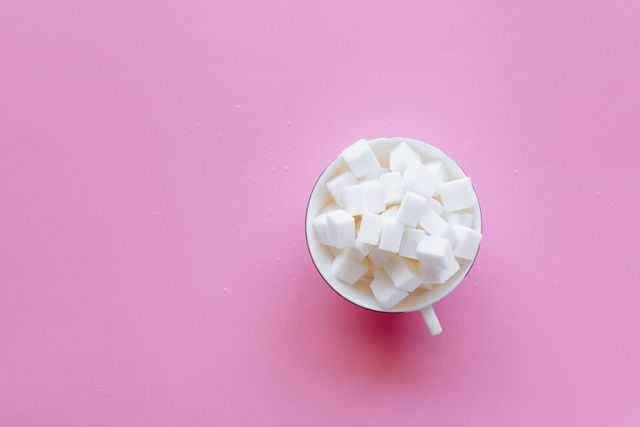
Sugar is wonderful. It’s sweet, sparkly, it gives energy. Sugar is essential for the body to function – it provides quick fuel. In nature, sugar is precious. It occurs mainly in ripe fruit and in honey – which are not easy to come by, so when sugar is available our body’s natural response is to consume as much as possible! But nowadays sugar is readily available. Today it is a relatively cheap ingredient added to make foods and drinks taste good.
Unfortunately though consuming lots of sugar is not a good thing. Sugar can damage our teeth (1) and fuel inflammation in the body (2). It can lead to weight gain and obesity (3).
Intense sweeteners are ingredients which taste sweet – sometimes many many times as sweet as sugar, and are added to foods and drinks in very small quantities.They provide little to no energy while still giving foods and drinks a sweet taste.
Intense sweeteners can be extracted from plants (natural) or produced (artificial). When added to foods or drinks, they are listed on the packaging as ingredients, either by their name or by a number.
The most common Artificial Sweeteners are:
Cyclamate (952): 30-50 times as sweet as sugar
Aspartame (951): 200 times as sweet as sugar
Neotame (961): 7000-13000 times as sweet as sugar
Saccharin (954): 300 times as sweet as sugar
Sucralose (955): 600 times as sweet as sugar
The most common Natural Sweeteners are:
Stevia (960): Extracted from a South-American plant Stevia rebaudiana. It can have a licorice-like taste.
Monk fruit: Extracted from the Luo Han Guo Fruit originating from China. It can have fruity taste.
Thaumatin (957): Originally extracted from the African Katemfe Fruit. A protein which mimics sweet taste on the tongue, but tastes and behaves somewhat different from sugar.
Xylitol (967): As sweet as sugar. Occurs naturally in birch wood. It promotes tooth health.
Erythritol (968): 60-70% of the sweetness of sugar.
So are intense sweeteners good or bad for you…?
People are divided on whether or not substituting sugar with intense sweeteners is a good idea or not. As always, there may not be a definite answer, and more research is constantly being done to determine safety and long-term effects.
Let me summarize the main arguments for and against the use of intense sweeteners:
Arguments against the use of Intense Sweeteners:
- They allow you to consume sweet foods and drinks guilt-free, essentially desensitizing you from sweet tastes
- They may trigger your body’s insulin response, making you feel hunger (4) and potentially leading to overeating and weight gain
- Some natural sweeteners can cause bloating, gas and diarrhea
- While they have been examined and approved for use in foods and drinks, we are not completely sure yet whether or not they can create harmful substances in the body (5)
- While they have little to no effect on the human body, they may affect gut bacteria
Arguments for the use of Intense Sweeteners:
- They provide little to no energy to the body, allowing you to enjoy sweet foods without over consuming energy
- They are not harmful (some are even beneficial) for oral health
- They have been evaluated by governments and deemed safe in the amounts used
- They are used in minimal amounts
- Natural sweeteners have a long history of traditional use
Whether or not you choose to replace some or all sugar in your foods and drinks with Intense Sweeteners is completely up to you. While we do not have all the answers just yet whether or not Intense Sweeteners are completely without effects, we do know the negative effects of eating too much sugar. For some people it may be easy to simply go without sweet food or drink. Others may not want to go without a sweet treat. In that case, opting for Intense Sweeteners, especially from natural sources, may be a health-conscious option.
References:
1 Ernest Newbrun, Sugar and Dental Caries: A Review of Human Studies.Science217,418-423(1982).DOI:10.1126/science.7046052
2 Ma X, Nan F, Liang H, Shu P, Fan X, Song X, Hou Y and Zhang D (2022) Excessive intake of sugar: An accomplice of inflammation. Front. Immunol. 13:988481. doi: 10.3389/fimmu.2022.988481
3 Emily J. Endy, So-Yun Yi, Brian T. Steffen, James M. Shikany, David R. Jacobs, Rae K. Goins, Lyn M. Steffen, Added sugar intake is associated with weight gain and risk of developing obesity over 30 years: The CARDIA study, Nutrition, Metabolism and Cardiovascular Diseases, Volume 34, Issue 2, 2024, Pages 466-474, ISSN 0939-4753, https://doi.org/10.1016/j.numecd.2023.10.022.
4 Vishwanath M. Sardesai, Tammi H. Waldshan, Natural and synthetic intense sweeteners, The Journal of Nutritional Biochemistry, Volume 2, Issue 5, 1991, Pages 236-244, ISSN 0955-2863, https://doi.org/10.1016/0955-2863(91)90081-F.
5 A.G. Renwick, The fate of intense sweeteners in the body, Food Chemistry, Volume 16, Issues 3–4, 1985, Pages 281-301, ISSN 0308-8146, https://doi.org/10.1016/0308-8146(85)90122-0.
Thank you for this clear information! I thougt Stevia was the only natural sweetner.