
You are probably quite familiar with an object called ‘Wallet’ for a currency called ‘Money’.
Most people used to own and carry a wallet with their money and debit cards inside, while these days paying cashless is becoming more frequent. Just for a moment, please imagine that you still carry a wallet with you.
Most people earn money by working and being paid – and then spend some of it to cover their essential expenses – housing (rent, mortgage), food, transportation (fuel, train fares etc), medical costs.
Hopefully you are keeping an eye on the amounts coming in and going out – you may even have a plan for all the comings and goings, which is called a ‘Budget’. It lists your planned and actual earnings against your planned and actual expenses – showing whether at the end of the week/month/year you spent more or less than what you made.
If you spend more than you make, you are in overdraft – you owe something. You need to make up for the shortfall by now working harder or spending less next time.
If you spend less than you make, then you have money left over. Either you treat yourself to some non-essentials – such as going to the movies, eating out, taking a holiday, or, if you are also keeping your future in mind, you may put some of the left-over money away into your bank account as Savings.
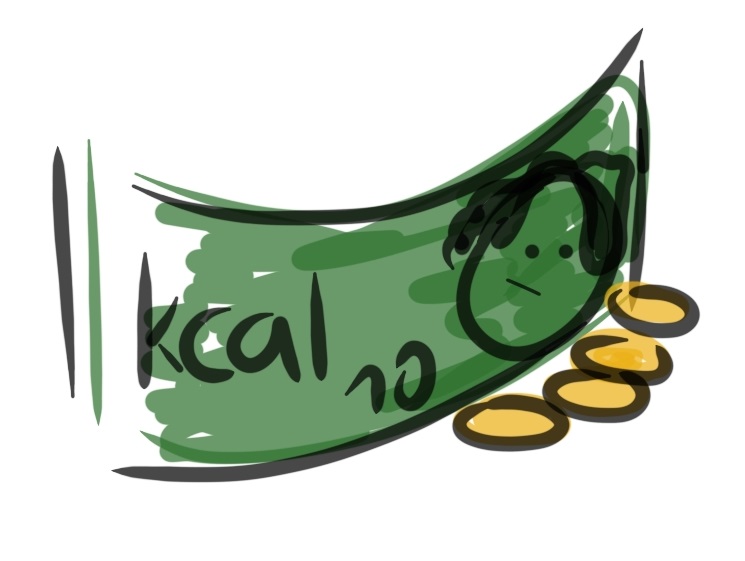
Now let me tell you that you carry a second Wallet for a currency called Calories. In fact, while not every human these days owns a money wallet, every human being definitely has a Calorie Wallet.
Every time you eat or drink, you earn Calories. The amount earned depends on how much you take in, and on the specific foods. So you get paid in Calories for the work you do, which is eating and digesting. These Calories from food and drink are being put
straight into your Calorie Wallet.
They are then used to pay the expenses of operating your body. Every minute you are alive, your breathing, your heartbeat, keeping warm, growing hair and nails etc. costs you Calories. These small but constant expenses, which keep your body
functioning, add up to a total essential housing cost. On top of this you must pay for transportation – or movement – if you move any part of your body. When you stand up and walk, it will cost a few Calories. If you just go about your life – work, drive, run
errands, cook, shower etc, these small additional expenses are added to your total daily expense. To cover them, you must earn enough Calories.
Now you may be thinking: No problem. My fridge is full, there is plenty of food, and just in case there isn’t I can just order some or go to the supermarket. Getting enough is not my problem.
Congratulations. You live in paradise.
If you can eat as much as you like and whatever you like, whenever you like it, you are part of a privileged minority. Just as there are people who have more money than they can spend, your challenge may not be the earning side, but the spending side. Please read on!
Let’s assume you live in abundance and can choose which foods to eat, select the highest quality products, and eat until you are full. In that case, you easily earn what you need and likely more. Now you could spend some extra, like treat yourself to something Calorie expensive – a workout session maybe, a hike, a game of basketball!
And your body is frugal and will not waste. Any extra Calories left after covering your daily expenses is automatically put towards savings.
There are two firm, very very important rules which make your Calorie wallet different from your money wallet:
1) You cannot overdraft.
If you spend more than you earn, and you do not have enough savings to cover the difference, you will die.
2) You do not have a bank account.
You must carry your savings with you, in bags, at all times. Your body stores these savings in the form of fat tissue and you do not get to leave them at home, ever. The more savings you have, the more weight you must carry with you, all day long.
Let’s now assume that you have trouble finding enough food and drink to cover your expenses. Or you may have enough one day, but not the next. In this case, since your body must keep functioning, it will use some of its savings. Your total savings will decrease, until you have a chance to top them up again.
Do you start to see how it works?
In upcoming posts we will dive deeper into different parts of your Calorie wallet, including learning how to increase and decrease your savings intentionally.